


EXPLORE ISSUES


The Artist Talks to BFS
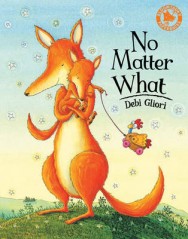
Award-winning and much-beloved children’s book author, Debi Gliori, is this year’s illustrator-in-residence at the Edinburgh International Book Festival. The author of such modern classics as No Matter What, What’s the Time, Mr. Wolf? and, most recently, Alfie in the Garden and Alfie in the Bath, she took a few minutes out of her busy schedule to talk to us about watercolours, dragons and the best advice she could ever give anyone.
BFS: Your work addresses the big questions of childhood, and touches on everything from the arrival of new babies to the fear of being alone, from non-conformity to environmental responsibility. How does illustration allow you to explore such complex topics, and do you adapt your style to individual themes?
DG: Illustration is an infinitely flexible gateway into exploring the big questions – it will boldly go where words cannot, or perhaps where words would express a difficult subject in too direct a fashion. In truth, when I begin to write a book, the first thing that comes to me ideas-wise is always an image. I write for and to and about the pictures in my head. The whole of my practice is about endeavouring to put those pictures down on paper without anything getting in the way. I’ve found that illustration allows me to explore some very sensitive themes in a way that doesn’t threaten the small children who the books are for. By drawing animals as my protagonists, I can tackle the big questions of childhood at one remove; children can identify with what the animals are feeling without themselves feeling in any way exposed.
I do adapt my style to whatever theme I’m working with; I’ve been using a smudgy, atmospheric charcoal style to convey the Antarctic winter in Dragon Loves Penguin but that darkness wouldn’t work for, say a book for much younger children, like Alfie in the Garden. My book about climate change required a lot of hot colours (the protagonists are flame-red dragons) and watercolour was the perfect medium. I’ve just completed artwork for a bedtime book called Goodnight World where I wanted smudgy, atmospheric darkness to slowly creep across the pages, but I also wanted the luminous quality of watercolour to portray that glorious, snug, all-tucked-in feeling of winter twilight; for that I used both watercolour and charcoal.
BFS: Artistry is a very personal endeavour. How much of your own experience finds its way into your work?
DG: Oh! Only my entire life. Suitably disguised, though. I am continually mining my past for the subject matter of my books, but usually not consciously. It tends to be only after a book is published and has been Out There for a few years that I suddenly realise where it came from. To my embarrassment, many of my characters are facets of myself at various stages of life… Who knew I was Mr Wolf? Or a grandma dragon? But there I am, gazing back at myself.
BFS: Where do you go looking for inspiration as you create new characters?
DG: Not far. I’m not very well-travelled. I do love walking as a means to dredge an idea up from the deep. There’s something about the rhythm of footsteps and the almost meditative trance I fall into as I walk that is the best way I know to access the place where ideas come from.
BFS: As the illustrator-in-residence this year at the Edinburgh International Book Festival, what kinds of conversations do you hope to have with your audiences?
 DG: Hugely varied conversations from the surreal banter I enjoy with very small children to the more rigorous questions coming from an adult audience, our subject matter will range widely from issues surrounding mental health, how to survive depression, how to bath a bunny or employ him usefully in a garden, how much of our personal lives do we pour into our books, what it felt like to be nearly killed by the Taliban, what we can do about our rapidly-heating planet and can ginger cats really count to a billion? What an amazing Book Festival we’re going to have!
BFS: Is there any advice you would give to aspiring writers and artists
DG: Unto your own self be true. I wrote this on an illustration for my godson, and I think it’s the best advice for anyone, regardless of their chosen profession. You are a unique human being; use that as the seedbed of all your endeavours. And read books by the thousands. Fill your head with stories.



ALSO IN THIS ISSUE

 Strawberry Éclairs with Elderflower Cream
Can’t quite make summertime in Paris? You can still enjoy a Parisian favourite.
ALSO ON BOOKS FROM SCOTLAND
-


The Savage Landscape by Cal Flyn
‘It is their resistance to the intrusions of the outside world − culturally, economically, environme …
-

The Shortest History of Scotland: A Q & A with Murray Pittock
‘We need to be better aware of that to understand the challenges and achievements of the past, and t …
-
David Robinson Interviews: John Lister-Kaye
‘I enjoy stillness. It creeps up on you and becomes almost a force. I’ve had squirrels run over my f …
-

Spring 2026 Round Up of Scots & Gaelic Releases
‘Discover Jansson’s uninhibited imagination full of love, kindness, and adventure.’
-

Walking Edinburgh’s Lost Railways By Robin Howie and John McGregor
‘In earlier times it was a site where lovers came to relax and dream, hence the beautiful traditiona …
-
David Robinson Reviews: The Loch of the Bees
‘The past’s current flows through the characters in his fiction so strongly that it almost becomes t …
FEATURED AUTHOR:
Seona Calder

Seona Calder was born and raised in Scotland. After studying art, she went on to work as an illustrator on various projects, including books on science, astronomy and animal behaviour. Seona claims that ‘living with a menagerie of animals over the year …
FEATURED PUBLISHER:
National Galleries of Scotland

Shortlisted for Saltire Society Publisher of the Year, 2016 National Galleries of Scotland Publishing is an established fine art and photography publisher. Our aim is to publish books with the highest design and production values which reflect the dive …