


EXPLORE ISSUES



The Artist Talks to BFS
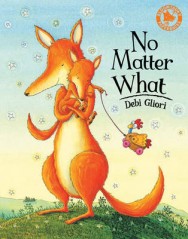
Award-winning and much-beloved children’s book author, Debi Gliori, is this year’s illustrator-in-residence at the Edinburgh International Book Festival. The author of such modern classics as No Matter What, What’s the Time, Mr. Wolf? and, most recently, Alfie in the Garden and Alfie in the Bath, she took a few minutes out of her busy schedule to talk to us about watercolours, dragons and the best advice she could ever give anyone.
BFS: Your work addresses the big questions of childhood, and touches on everything from the arrival of new babies to the fear of being alone, from non-conformity to environmental responsibility. How does illustration allow you to explore such complex topics, and do you adapt your style to individual themes?
DG: Illustration is an infinitely flexible gateway into exploring the big questions – it will boldly go where words cannot, or perhaps where words would express a difficult subject in too direct a fashion. In truth, when I begin to write a book, the first thing that comes to me ideas-wise is always an image. I write for and to and about the pictures in my head. The whole of my practice is about endeavouring to put those pictures down on paper without anything getting in the way. I’ve found that illustration allows me to explore some very sensitive themes in a way that doesn’t threaten the small children who the books are for. By drawing animals as my protagonists, I can tackle the big questions of childhood at one remove; children can identify with what the animals are feeling without themselves feeling in any way exposed.
I do adapt my style to whatever theme I’m working with; I’ve been using a smudgy, atmospheric charcoal style to convey the Antarctic winter in Dragon Loves Penguin but that darkness wouldn’t work for, say a book for much younger children, like Alfie in the Garden. My book about climate change required a lot of hot colours (the protagonists are flame-red dragons) and watercolour was the perfect medium. I’ve just completed artwork for a bedtime book called Goodnight World where I wanted smudgy, atmospheric darkness to slowly creep across the pages, but I also wanted the luminous quality of watercolour to portray that glorious, snug, all-tucked-in feeling of winter twilight; for that I used both watercolour and charcoal.
BFS: Artistry is a very personal endeavour. How much of your own experience finds its way into your work?
DG: Oh! Only my entire life. Suitably disguised, though. I am continually mining my past for the subject matter of my books, but usually not consciously. It tends to be only after a book is published and has been Out There for a few years that I suddenly realise where it came from. To my embarrassment, many of my characters are facets of myself at various stages of life… Who knew I was Mr Wolf? Or a grandma dragon? But there I am, gazing back at myself.
BFS: Where do you go looking for inspiration as you create new characters?
DG: Not far. I’m not very well-travelled. I do love walking as a means to dredge an idea up from the deep. There’s something about the rhythm of footsteps and the almost meditative trance I fall into as I walk that is the best way I know to access the place where ideas come from.
BFS: As the illustrator-in-residence this year at the Edinburgh International Book Festival, what kinds of conversations do you hope to have with your audiences?
 DG: Hugely varied conversations from the surreal banter I enjoy with very small children to the more rigorous questions coming from an adult audience, our subject matter will range widely from issues surrounding mental health, how to survive depression, how to bath a bunny or employ him usefully in a garden, how much of our personal lives do we pour into our books, what it felt like to be nearly killed by the Taliban, what we can do about our rapidly-heating planet and can ginger cats really count to a billion? What an amazing Book Festival we’re going to have!
BFS: Is there any advice you would give to aspiring writers and artists
DG: Unto your own self be true. I wrote this on an illustration for my godson, and I think it’s the best advice for anyone, regardless of their chosen profession. You are a unique human being; use that as the seedbed of all your endeavours. And read books by the thousands. Fill your head with stories.




ALSO IN THIS ISSUE

 Scottish Book Trust New Writers Award
Introducing New Writer Awardees Rachelle Atalla and Lindsay Macgregor
ALSO ON BOOKS FROM SCOTLAND
-

The Broons and Oor Wullie Celebrate their 90th Birthdays!
‘Whatever the future may hold, we can be sure that The Broons and Oor Wullie will always be a part o …
-

Pretty Valuable Things by A. J. Leslie
Harper considered Charles for a few moments, lit a cigarette, then said ‘we are treating it as murde …
-
Shadow of Madness: A Q & A with D. V. Bishop
‘Yet a great novel of historical fiction also has us escape the here and now by immersing us in the …
-

‘I don’t think I decided to become a writer. I just was.’
-

Lessons From Scottish Schools: A Q & A with Lindsay Paterson
Ten years will not be enough to restore Scotland to where it was in the past…
-
Saltwater: A Midsummer Ghost Story by Elaine Thomson
‘The very thought of those grey faces made my skin grow cold.’
FEATURED AUTHOR:
Mark Mechan

Mark Mechan grew up in Broughty Ferry with his mum and dad, and is the youngest of four siblings — two sisters and a brother. He went to Forthill Primary and Dundee High, then to Duncan of Jordanstone College of Art in 1988 where he studied Drawing …
FEATURED PUBLISHER:
404 Ink

404 Ink is an alternative book publisher based in Edinburgh. Established in mid 2016 we sought to provide an alternative literary programme for the Scottish reader market and beyond by publishing unusual fiction, non-fiction, poetry and comics in Engli …