Witchcraft in Early Modern Scotland: An Introduction to the Topic and the Literature
By Hugh V McLachlan
School of Law and Social Sciences, Glasgow Caledonian University
When Scotland had a sovereign Parliament of its own, one of its most intriguing Acts was that of 1563 which made witchcraft a capital offence. Much has been written about witchcraft in Scotland ever since. For instance, in 1591, a booklet called Newes from Scotland was published. This was about the trial of several people who were accused of bewitching the king of Scotland, James VI, who became, with the union of the crowns in 1603, James VI and I. James himself wrote a short philosophical treatise on witchcraft called Dæmonologie, which was published in 1597. Two central questions that always arise when one reads about Scottish witchcraft are: is what is written truthful?, and is it true?
Newes from Scotland purports to be a true account of:
'…the damnable life of Doctor Fian a notable sorcerer who was burned in Edinburgh in Januarie last 1591, which doctor was register to the Devil that sundry times preached at North Barwick Kirke to a number of notorious witches, with the true Examinations of the said Doctor and witches as they uttered them in the presence of the Scottish King: Discovering how they pretended to bewitch and drown his Majestie in the sea, coming from Denmarke; with such other wonderful matters as the like hath not been heard at any time.'
Much of what is said in the booklet is true. For instance, it reports quite accurately that John Fian was a school-teacher and that he was horribly tortured. His finger-nails were pulled out and pins driven into the exposed areas. His legs were placed inside hollow tubes and wedges of wood were hammered between his legs and the inside of the tubes. His legs were shattered and the marrow from his bones oozed away. This torture was called, with the curious Scottish fondness of the coy diminutive, 'the bootikins'.
It is also said that the following story was told in the evidence against him at his trial. He was, so the story goes, sexually attracted to a teenaged girl and he attempted without success to seduce her. The girl shared a bed with her brother, who was one of John Fian's pupils. Fian threatened to birch the boy unless he gave him several of his sister's pubic hairs. This proved more difficult to do that the teacher had envisaged. The girl complained to her mother about her brother's strange behaviour. The boy was thrashed by his mother until he confessed to her what he had been trying to do and why he had been trying to do it. The mother then went into a nearby field and plucked several hairs from the udder of a virgin cow. At his mother's request, the boy gave them to his teacher and told him that they were his sister's pubic hairs. Thereafter, the teacher was followed around Haddingtoun by a love-sick cow. This, according to the booklet, was regarded at his trial as evidence that he had performed witchcraft on the hairs from the cow in the mistaken belief that they had come from the girl.
This is a neat story. However, it appears to be both untrue and untruthful: it is dishonest and not merely false. In the copious records relating to the case, there is no mention of this tale. There is no indication at all that it featured as part of the evidence in the case against John Fian. It was, I suggest, an invention. The story is a hoot and was meant to be a hoot. It made Newes From Scotland even more of a popular success in England than it might otherwise have been partly, I suggest, because it made the Scottish courts look more ridiculous than they were.
A Source-book of Scottish Witchcraft
In 1938, George F. Black, a Scotsman who was in charge of New York Public library, published A Calendar of Cases of Witchcraft in Scotland 1510-1727. This was a fairly comprehensive compilation of brief accounts of references, in printed sources, to Scottish witchcraft cases. In 1977, A Source-book of Scottish Witchcraft, compiled by Larner, Lee McLachlan was published. It built upon Black's study but went beyond it by including, through an examination of actual manuscripts, information on previously unpublished cases. It also presented the material in a more systematic way in relation, where known, to the names of the accused witches, their sex, their fate, the place of the case, its date and the type of court that dealt with it. Some such information is presented in the form of tables. Transcriptions of documents pertaining to witchcraft trials - such as examples of the evidence of supposed witnesses - and other salient legal documents - including, for instance, an account of when and why the testimony of female witnesses might be legally acceptable in Scottish courts - are also presented. A Source-book of Scottish Witchcraft is the most authoritative reference book on Scottish Witchcraft. It was reprinted in 2005.
Recently, the team of the "Survey of Scottish Witchcraft 1563-1736" at Edinburgh University - Julian Goodare, Louise Yeoman, Joyce Miller and Lauren Martin - used the Source-book as the basis of a study, the results of which are now available on-line. (See: www.arts.ed.ac.uk/witches ). In general, web-sites about witchcraft must be regarded very sceptically, particularly by those who are interested in discovering the truth about the history of witchcraft. However, this particular web-site can be highly recommended for use in addition to, although not as a replacement for, books about Scottish witchcraft.
Among the books that are particularly worth recommending to any one who is interested in learning about witchcraft accusations and prosecutions in early modern Scotland are the following: The Enemies of God by Christina Larner; The Scottish Witch-Hunt in Context by Julian Goodare: The Witches of Fife by Stuart MacDonald; Satan's Conspiracy by P.G. Maxwell Stuart; Witchcraft in Early Modern Scotland by Normand and Roberts; The Witch Hunt in Early Modern Europe by Levack. In many respects, Larner's book is pivotal in that many subsequent studies are reactions, of various sorts, to it. She was the main pioneer of the currently fertile field of academic study of Scottish witchcraft.
Witchcraft in Scotland in the 16th and 17th Centuries
Witchcraft in Scotland was thought of in essentially theological terms by the educated elite. It was considered as a sort of inverse of Christianity. It was believed that the devil appeared to prospective witches in the form of a man. People were thought to become actual witches by the voluntary act of entering into a pact with him and renouncing Christ and their Christian baptism to him. They became the servants of the devil and enemies of God rather than followers of Christ. To become a witch was a wilful act. Exercises of witchcraft - and this could be the use of diabolical power to help as well as to harm people (beneficium as well as maleficium) - were also thought of as wilful and, of course, sinful acts. Witches were believed to hold meetings with other witches at which the devil presided.
There were at least three aspects to the crime of witchcraft in the 16th and 17th centuries (not all of which featured in every case). There was the alleged spiritual offence of being in league with the devil. There was the alleged physical harm done by accused witches (maleficium). There was the offence of purporting to have supernatural powers.
Among the population as a whole, witchcraft did not necessarily have this sinister, theological association. Belief in witchcraft could merge with all sorts of other beliefs about supernatural and supernormal entitles and occurrences. (See Henderson and Cowan, 2001)
Rationality, Justice and Witchcraft Trials
Among non-specialists, the commonly held view of 16th and 17th century witchcraft trials and pre-trial investigations is that they were unfair, unjust and irrational procedures and that those who were accused were innocent but were invariably found guilty - often as a result of confessions induced by torture - and executed. However, Scottish witchcraft was not precisely like this. The study of Scottish witchcraft is more complex and interesting than the crude but popular stereotypes would suggest.
The Source-book reveals that of all the then-known Scottish witchcraft trials between 1560 and 1730, where the fate of the accused witch was discovered, 53.9 per cent were executed; 4.8 per cent received non-capital punishments; 26.8 per cent were acquitted; and 14.5 per cent had miscellaneous fates - for instance, the suspect died in prison or fled (See Larner, Lee and McLachlan, 2005, pp. 236-41.)
The conclusion that not all those who were tried for witchcraft were executed is echoed by the recent Survey of Scottish Witchcraft of Edinburgh University which identifies 3,212 named accused witches in Scotland between 1563 and 1736 (not all of whom were actually put on trial for witchcraft). The question of how many accused witches were executed is answered in the Survey in the following way:
'It's hard to tell, but certainly not all. Of the 3,212 named individuals, we know of the sentence of a trial in only 305 cases. 205 of these were to be executed, 52 were acquitted, 27 were banished, 11 were declared fugitive, 6 were excommunicated, 2 were put to the horn (outlawed), 1 person was to be kept in prison and 1 person was to be publicly humiliated. In addition, a further 98 were recorded as having fled from prosecution'. ( http://www.arts.ed.ac.uk/witches )
With regard to the question of the fairness of witchcraft trials, one must be aware of what the crime of witchcraft actually was in Scotland. For instance, one did not need to be a successful witch in order to be guilty in law of the crime of witchcraft. One's witchcraft did not need to 'work'. In terms of the Scottish Witchcraft Act of 1563, it was a crime – it was a capital offence – for any person to use: 'Witchcraftis Sorsarie or Necromancie nor gif thame selfis furth to have any sic craft or knawledge thairof thairthrow abused the pepil.' It was, that is, a crime not only to use witchcraft, sorcery and necromancy, it was a crime to purport to be able to do so. It was also a capital offence to consult witches. The conclusion is unavoidable that at least some of those who were found guilty of witchcraft were guilty as charged.
Were all Witches Female?
Prior to the bulk of the actual witchcraft hunts trials, James VI had speculated, in 1597, that the ratio of female to male witches was 20:1, i.e. that only 4.8% of witches would be male. His famous explanation for the assumed preponderance of female witches was as follows:
'The reason is easie, for as that sexe is frailer than men is, so it is easier to be intrapped in these grosse snares of the Devil, as was over will proved to be true, by the Serpent's deceiving of Eva at the beginning, which makes him the homlier with that sexe sensine'
Similarly, nowadays, people tend to imagine that supposed witches were always or almost always female.
In actual fact, far more males were involved that the current stereotype or James's speculation would suggest. In Scotland, of those people who were tried as witches or against whom formal proceedings regarding witchcraft were instigated, 86% were female and 14% were male.
Notice that the question of whether or not there was a sexual bias against females in relation to witchcraft cases is a complex one. After all, most people who are tried for, say, murder are males but we do not automatically say that this shows that the law is biased against males. Indeed, in general most of those who are tried for most crimes are male. As McLachlan and Swales show, there is no convincing evidence of a sexual bias against females in witchcraft cases within the formal legal system. Of those who were formally charged with and tried for witchcraft, their chances of being acquitted, executed and the like were unrelated to their sex. (See McLachlan and Swales, 1979, 1980 and 1994)
A Source-Book of East Lothian Witchcraft
Goodnight My Servants All: A Source-book of East Lothian Witchcraft by David M. Robertson will be published shortly. It is a compilation of primary material about cases of witchcraft in East Lothian along with useful annotation and perceptive commentary. Robertson attempts to strip away the accumulated layers of interpretation that have been imposed upon the records of the witchcraft cases. In addition to the annotated transcriptions there is, among other things, an analysis and interpretation of witchcraft in East Lothian and a summary of James VI and I's Dæmonologie.
The Paisley Witchcraft Trial of 1697
The Bargarran witchcraft case, with its subsequent trial in Paisley in 1697, is one of the most tantalising and perplexing of all the Scottish witchcraft cases. Recently, much material relating to it, some of which has never been published before, has been presented in The Kirk, Satan and Salem: A History of the Witches of Renfrewshire, (McLachlan, 2006)
The case has achieved a lasting notoriety through the involvement of Christian Shaw - the so-called 'Bargarran Impostor'. She is traditionally thought to have been responsible, through cunning and malicious accusations, for the deaths of several people who were executed as witches. In later life, she played an important part in the formation and development of Paisley's sewing thread industry. At the time of the trial, she was eleven years old.
It was alleged that, when no one in the room apart from Christian could see them, people would torment the child. They would, for instance, nip and bite her and force things into her mouth. The child would later show the marks of the nips and the bites and, in the presence of observers, remove the objects from her mouth. She would have fits in which she would appear to be blind, deaf and unable to speak. Her body would become horribly contorted and she would cry out in distress. Between her fits and her other strange reported performances and experiences, she was said to have been happy and well.
Seven people were tried – four women and three men. They were: Katherine Campbell; Agnes Naismith; Margaret Fulton; Margaret Lang; John and James Lindsay – aliases Bishop and Curate, respectively; and another John Lindsay from Barloch. They were all found guilty and executed.
In order to try to understand the Bargarran witchcraft case of 1697, it is useful to see, as the book shows, how strikingly similar it was to the famous outbreak of witchcraft in Salem, New England in 1692 as described and analysed by the Rev Deodat Lawson. He had been a minister at Salem and returned there to write the very first account that was ever published about the witch-hunt there. It was called:
A Brief and True Narrative of some Remarkable Passages Relating to sundry Persons Afflicted by Witchcraft at Salem Village: Which happened from the Nineteenth of March to the Fifth of April, 1692.
It is remarkably similar to the account that was published in 1698 about the supposed bewitchment of Christian Shaw called:
A True Narrative of the Sufferings and Relief of a Young Girle; Strangely molested by Evil spirits and their instruments in the West: With a preface and postscript containing Reflections on what is most Material or Curious either in the history or trial of the Seven Witches who were Condemn'd to be Execute in the country.
Both of these Narratives are reprinted in The Kirk, Satan and Salem. Among the other material, there is, for instance: 'The Bargarran Witchcraft Trial: A Psychiatric Reassessment', McDonald, Thom and A. Thom; Exonerate the Erskine One' by McLachlan and Swales; and a substantial, previously unpublished document which shows the Bargarran case and role of Christian Shaw in it on a wider canvass and in a far brighter light.
Conclusion
Irving Goffman, the illustrious Canadian social scientist, made a useful distinction between information, misinformation and disinformation. He was talking particularly about espionage at the time – about lying and spying and about pretending to be lying when acting, or pretending to be acting, as a spy - but the distinction has a general application. (See Goffman, 1969) I have already suggested that I think that the story of John Fian and the love-sick cow is not information: it is not merely misinformation but deliberate disinformation.
Goffman cites instances of British secret agents in the Second World War being told – untruly and untruthfully - that they were being entrusted, in utmost confidentiality, with the details of when and where the D-day landing would be. They were then deliberately parachuted into Europe at such a time and place when and where they were likely to be captured and tortured by the Nazis. When they were captured then tortured and in bitter anguish told their tormentors where and when they thought the landings would be, they believed that what they were saying was true. It was, of course, nonsense. The agents had been fed misinformation deliberately: they had been, in Goffman's terms disinformed.
How can we tell the difference between information, misinformation and disinformation? There is no simple way to do so. Merely because someone says something or writes something down is no reason to believe either that what is said or written is true or that it is believed by whoever said or wrote it to be true. For instance, when accused witches say that they are guilty of witchcraft and that they met the devil, who was in the form of a man, and that they renounced Christ and their baptism to the devil, we do not necessarily have a reason to believe that what they say is true. We do not necessarily have a reason to believe that they believed that what they said is true. When we read that people who were accused of being witches confessed, we might well even reasonably doubt whether a confession of any sort was made.
This does not mean that the attempt to discover the truth about the history of Scottish witchcraft is completely impossible but it does mean that it is not easy. It means that it is a complex and interesting area of study. There is a temptation to think that if we can only get to the primary sources and if we can only shed our preconceptions and interpretations, we shall discover the truth. Primary sources, like all possible sources of information are important. However, they will not speak for themselves. Like any other sources, they require interpretation. What is required, I suggest, in order to try to discover the truth about Scottish witchcraft – as about any other area of study – is not the absence of interpretation but better interpretations. More reading - deeper and wider reading - does not guarantee such better interpretations but it can help. Nothing else can.
-
Add to BasketThe Kirk, Satan And Salem: A History Of The Witches Of Renfrewshire - Paperback
£25.00
This book is about the famous outbreak of witchcraft allegations and prosecutions associated with Christian Shaw, the so-called 'Bargarran Impostor', in Renfrewshire in the 1690s. -
Add to BasketThe Scottish Witch-Hunt In Context - Paperback
£16.99
Covering the whole period of the Scottish witch-hunt, from the mid-16th century to the early 18th, this book is a collection of essays on Scottish witchcraft and witch-hunting. It provides a comparative dimension of witch-hunting beyond Scotland. -
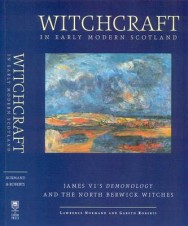
Add to BasketWitchcraft In Early Modern Scotland: King James VI's Demonology And The North Berwick Witches - Paperback
£17.99
From 1590 to 1596, Scotland saw its first major witch-hunt. This book examines the political, demonological and cultural forces which shaped the North Berwick witchcraft case, and provides edited texts of the accounts of the trials of these witches.
Bibliography
- Anonymous (1591) Newes from Scotland, Declaring the damnable life of Doctor Fian, London: William Wright.
- Black, George, F. (1938), A Calendar of Cases of Witchcraft in Scotland 1510-1727, New York: New York Public Library.
- Goffman, Irving (1969) Strategic Interaction, University of Pennsylvania Press.
- Goodare, Julian(editor), (2002) The Scottish Witch-Hunt in Context, Manchester: Manchester University Press.
- Henderson, L. Cowan, E.J.(2001) Scottish Fairy Belief: A History, East Linton: Tuckwell.
- James VI and I (1597) Dæmonologie, in Forme ane Dialogue, Edinburgh: Robert Walde-Grave.
- Larner, Christina (1981) Enemies of God: The Witch-hunt in Scotland, London: Chatto and Windus.
- Larner, Christina, Lee, Christopher Hyde and McLachlan, Hugh V. (2005) A Source-Book of Scottish Witchcraft, Glasgow: The Grimsay Press.
- Levack, Brian P. (1995) The Witch Hunt in Early Modern Europe, London and New York: Longman.
- Macdonald, Stuart(2002) The Witches of Fife: Witch-hunting in a Scottish Shire 1560-1710, East Linton: Tuckwell Press.
- McLachlan, Hugh V. (editor) (2006) The Kirk, Satan and Salem: A History of the Witches of Renfrewshire, Glasgow: The Grimsay Press.
- McLachlan, Hugh V. and Swales, J. K. (1979), 'Witchcraft and the Status of Women: A Comment', British Journal of Sociology, Vol. 30, No. 3, pp. 349-358.
- McLachlan, Hugh V. and Swales, J. K. (1980), 'Witchcraft and Anti-Feminism', Scottish Journal of Sociology, vol. 4, no. 2, 141-166.
- McLachlan, Hugh V. and Swales, J. K. (1994), 'Sexual Bias the the Law: The Case of Pre-Industrial Scotland', International Journal of Sociology and Social Policy, Vol. 14, No. 9, pp. 20-39.
- Maxwell-Stuart, P.G. (2001) Satan’s Conspiracy, East Linton: Tuckwell Press.
- Robertson, David M. (forthcoming, 2007) Goodnight My Servants All: A Source-book of East Lothian Witchcraft, Glasgow: The Grimsay Press.